Athlemetrics API: Redefining Football Data Intelligence
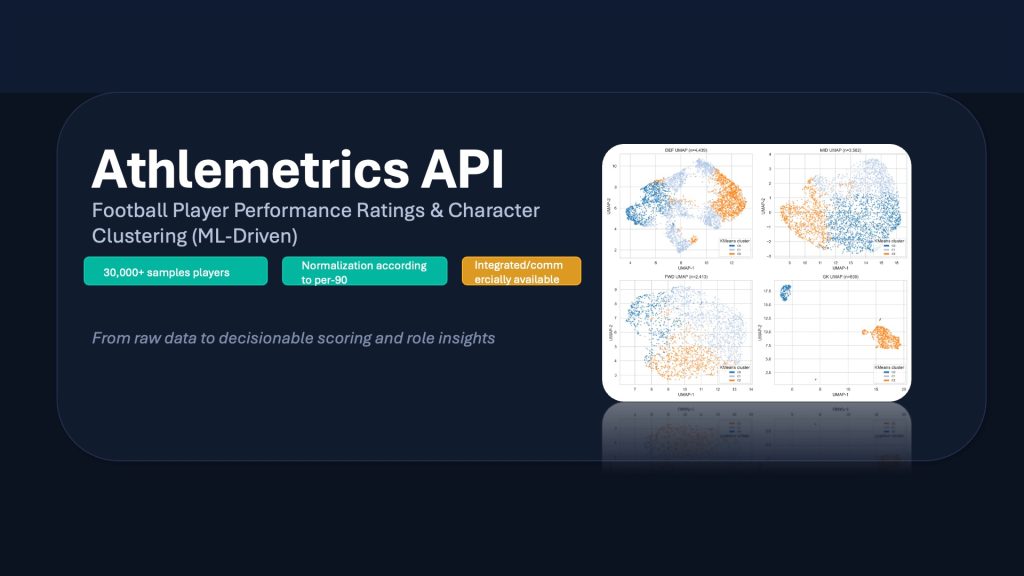
Stop relying on raw stats. Start using decision-ready intelligence. Athlemetrics transforms fragmented match data into standardized Per-90 ratings and ML-driven role insights. Trained on over 30,000 player samples, our engine helps scouts, analysts, and developers uncover the true “style” of a player—visualized instantly through our high-dimensional UMAP clustering technology.
30k+ Samples
Deep Historical Data
Per-90 Norm
Standardized Ratings
Decision Ready
Commercially Available
Model Output Preview
Why do you need Athlemetrics?
Think of it as a translation layer: stats → standardized ratings, and features → role tags. Once your outputs are normalized and addressable through endpoints, you can iterate faster and reuse everything across leagues and seasons.
Key Challenges
- Fragmented Data Sources: Inconsistent calibers across different leagues and sample sizes make direct comparison impossible.
- Hard to Compare: Differences in playing time and position often lead to significant bias in traditional indicators.
- Implementation Gap: Research conclusions are often difficult to quickly commercialize or reuse effectively.
Target Contributor
- Club/Scout: Recruitment screening and reinforcement matching.
- Analyst: Opponent research, tactical portraits, and season tracking.
- Media/Content: Generating lists, comparisons, and visual data stories.
- Research/Business: Integration of indicator systems with data products.
Core Commitments
- Normalized Statistics: Per-90 minutes stats normalized as input to output a comparable composite score (0-10).
- Style Clustering: Provide “Player Role/Style” cluster tags and query interfaces to support similarity analysis.
- API Delivery: Delivered via API for faster iteration, easier integration, and better reusability.
Product Overview
Athlemetrics API: An all-in-one interface engineered around
“Scoring + Roles + Data Retrieval”.
Base Score
Use kit_name + payload as input to return a normalized score and a module breakdown for comparison.
Database
Fetch historical records with scores using filters. Built for leaderboards, filtering, and backtesting.
Player Role
Cluster players by style. Includes legend explanations and supports custom inputs for prediction.
API Design Essentials
- Request Object: Standardized kit_name + payload structure.
- Output: Composite score + detailed breakdown.
- Dynamic UI: Slider-params for adjustable weighting.
- Scalability: Optional 0-10 or 0-100 scales.
- Role Clustering: Supports both historical record and custom input modes.
Delivery Form
OpenAPI 3.1 Contract
+ REST Interface
Developer & Integration Guide
The Athlemetrics API is designed to be language-agnostic and easy to implement. Whether you are running a batch analysis script in Python or building a live React dashboard, our endpoints follow standard RESTful conventions.
POST Predict Base Score
This is the core engine. You provide the raw match statistics (normalized per 90), and the model returns a composite rating (0-10) along with a detailed feature breakdown.
Tip: You can choose between gb (Gradient Boosting) or ridge models depending on your preference for volatility vs. stability.
import requests

url = "https://api.athlemetrics.com/base-score/predict"
data = {
    "kit_name": "attacker_core",
    "model_type": "gb",
    "score_scale": "0-10",
    "payload": {
        "minutes": 1800,
        "goals_per90": 0.55,
        "xg_per90": 0.48,
        "shots_total_per90": 3.2
        # ... other required stats
    }
}

response = requests.post(url, json=data)
print(response.json())[
{
"name": "Erling Haaland",
"season": 2024,
"league": "Premier League",
"base_score_10": 9.4,
"attack_score": 9.8,
"creation_score": 6.5
},
// ... more records
]GET Query Dataset
Need historical context? Use the Dataset endpoint to filter over 30,000 player seasons. It is perfect for building leaderboards, backtesting strategies, or finding comparable players.
Endpoint: /database/base-score/dataset
Ready to get started?
Transparent Model Validation
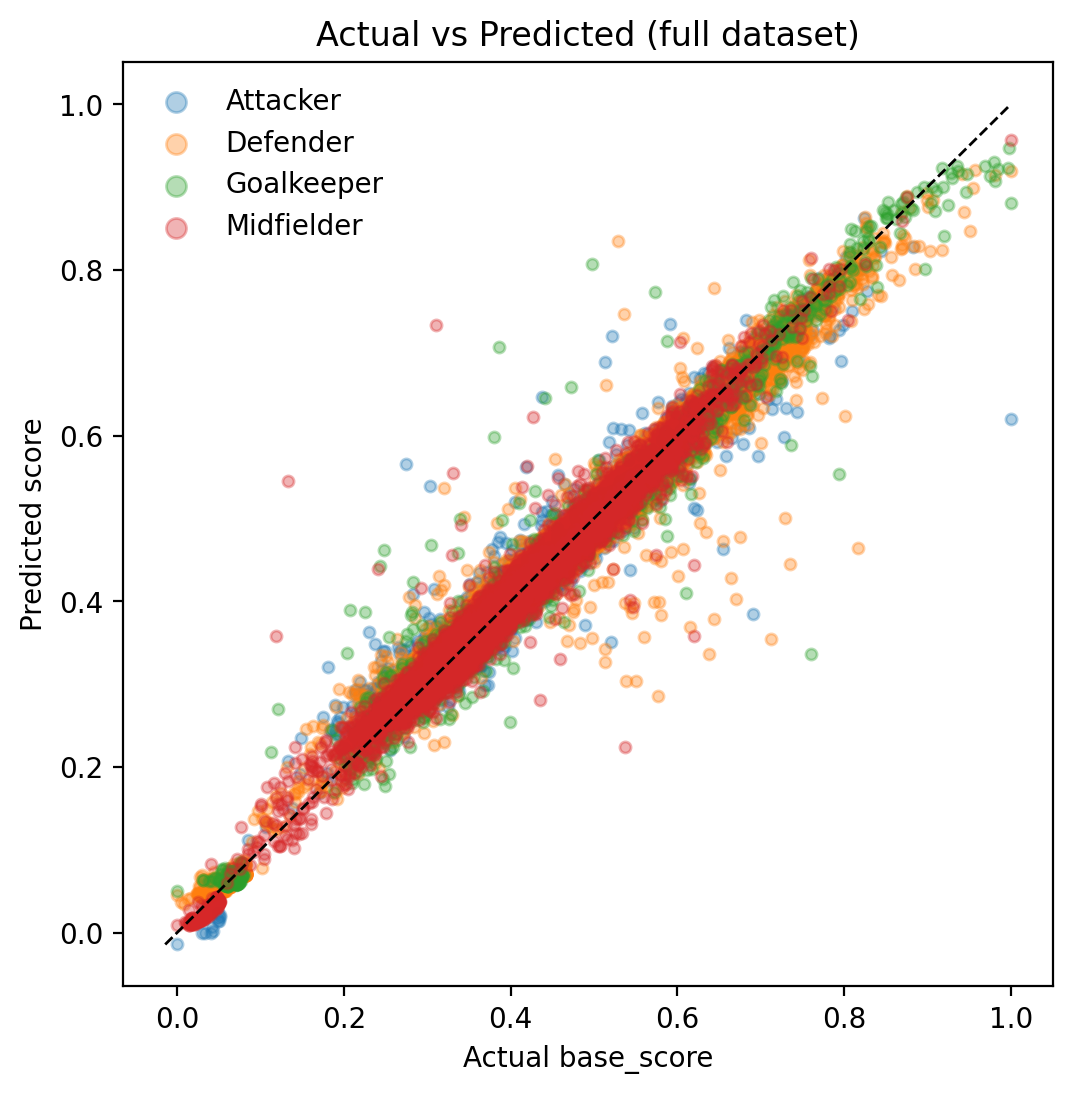
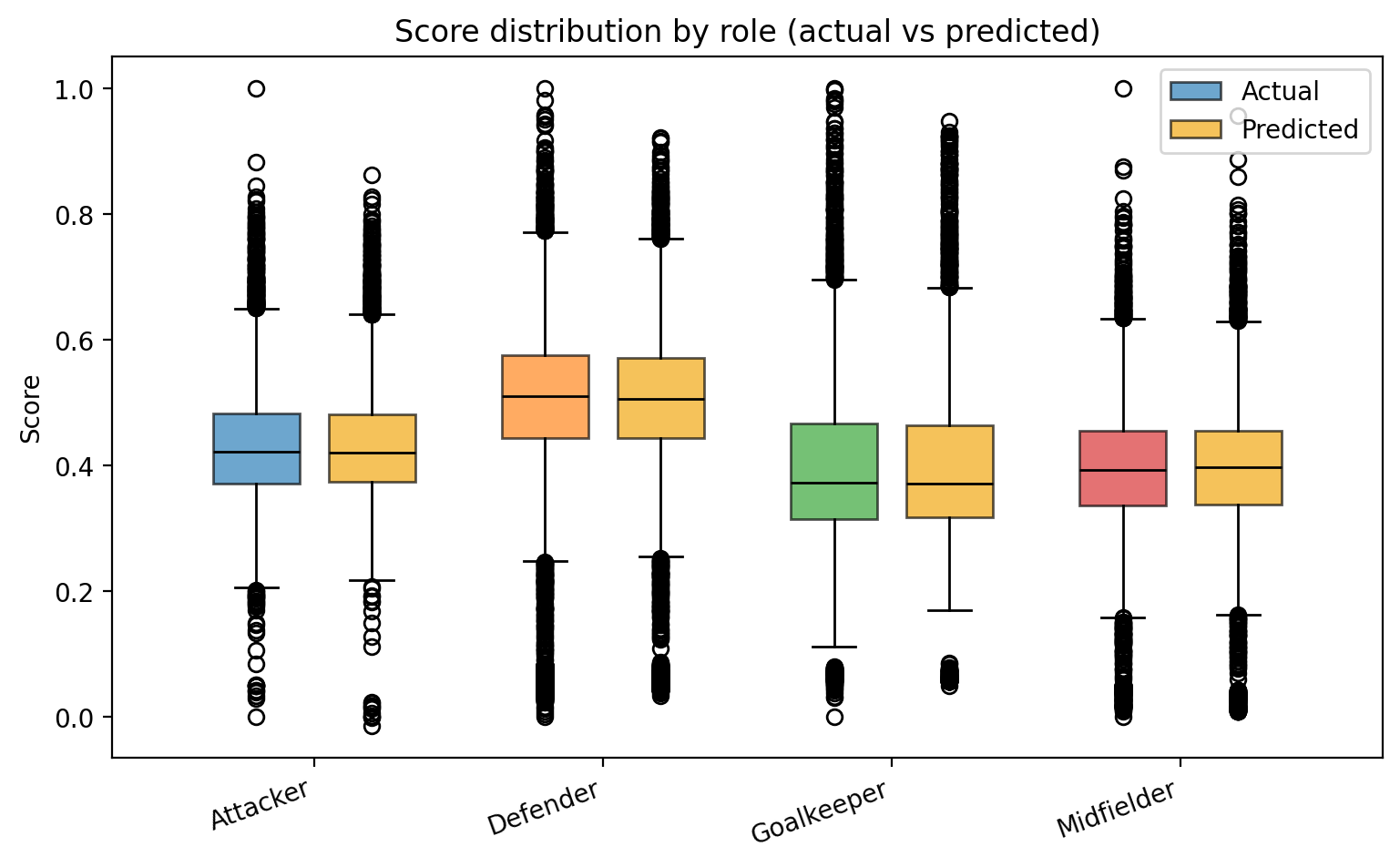
We don’t believe in “black boxes”. Athlemetrics is rigorously tested on over 30,000 player samples. Below is the operational performance of our deployed models.
Rating Precision
Ensuring scores (0-10) reflect on-pitch reality without systematic bias.
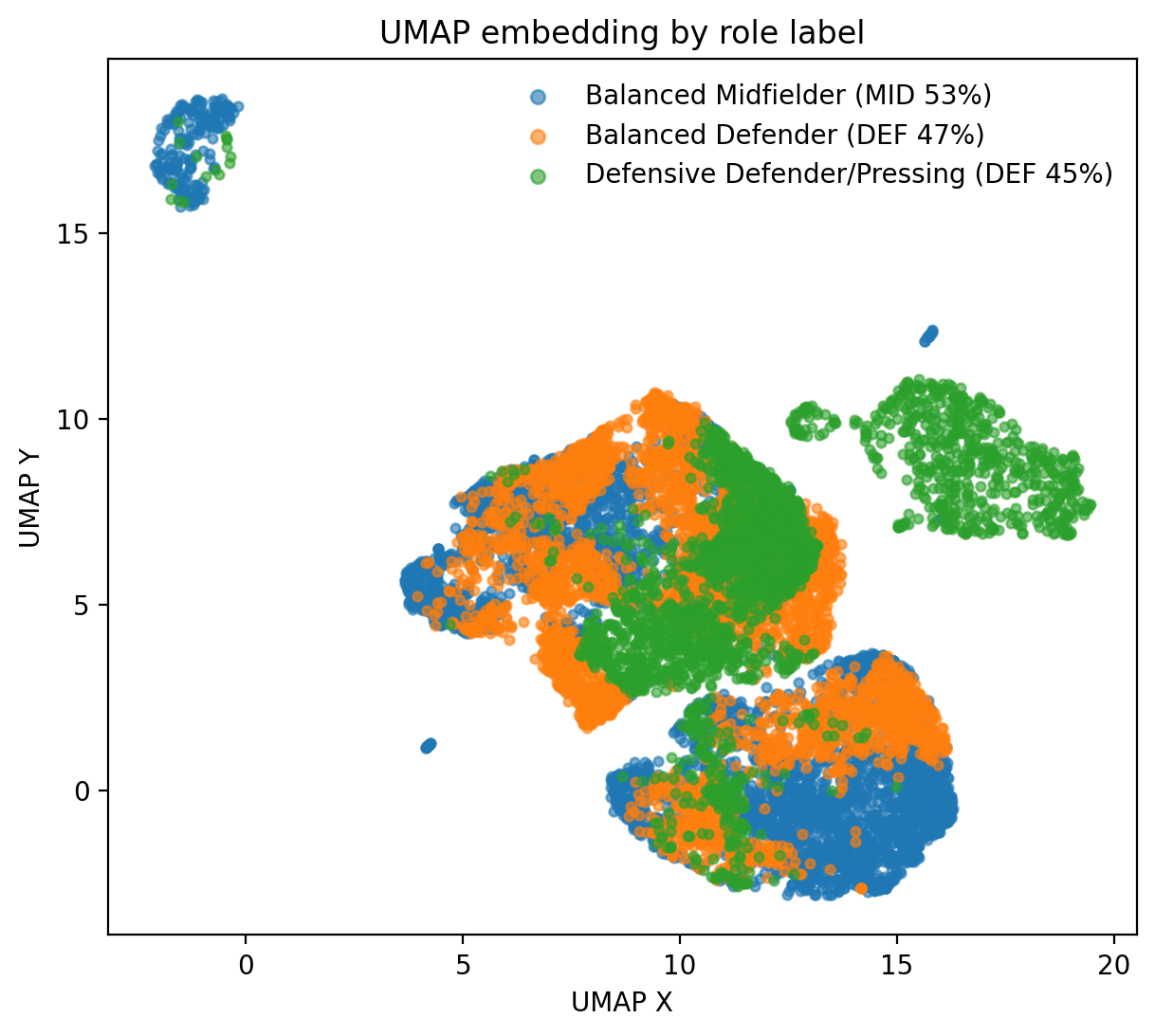
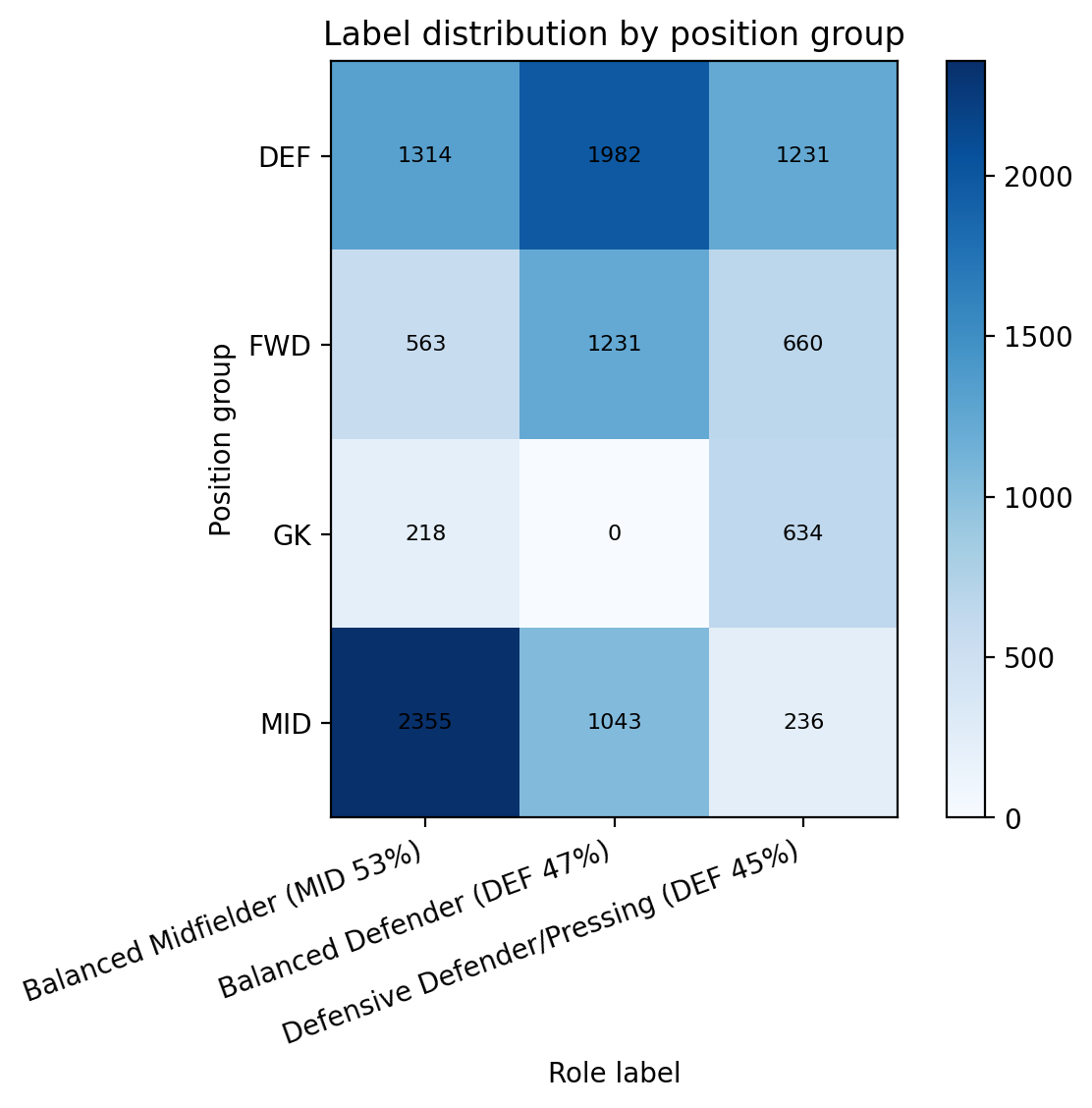
Role Clustering
Unsupervised learning (UMAP) to discover distinct playing styles beyond traditional positions.
Developer Experience
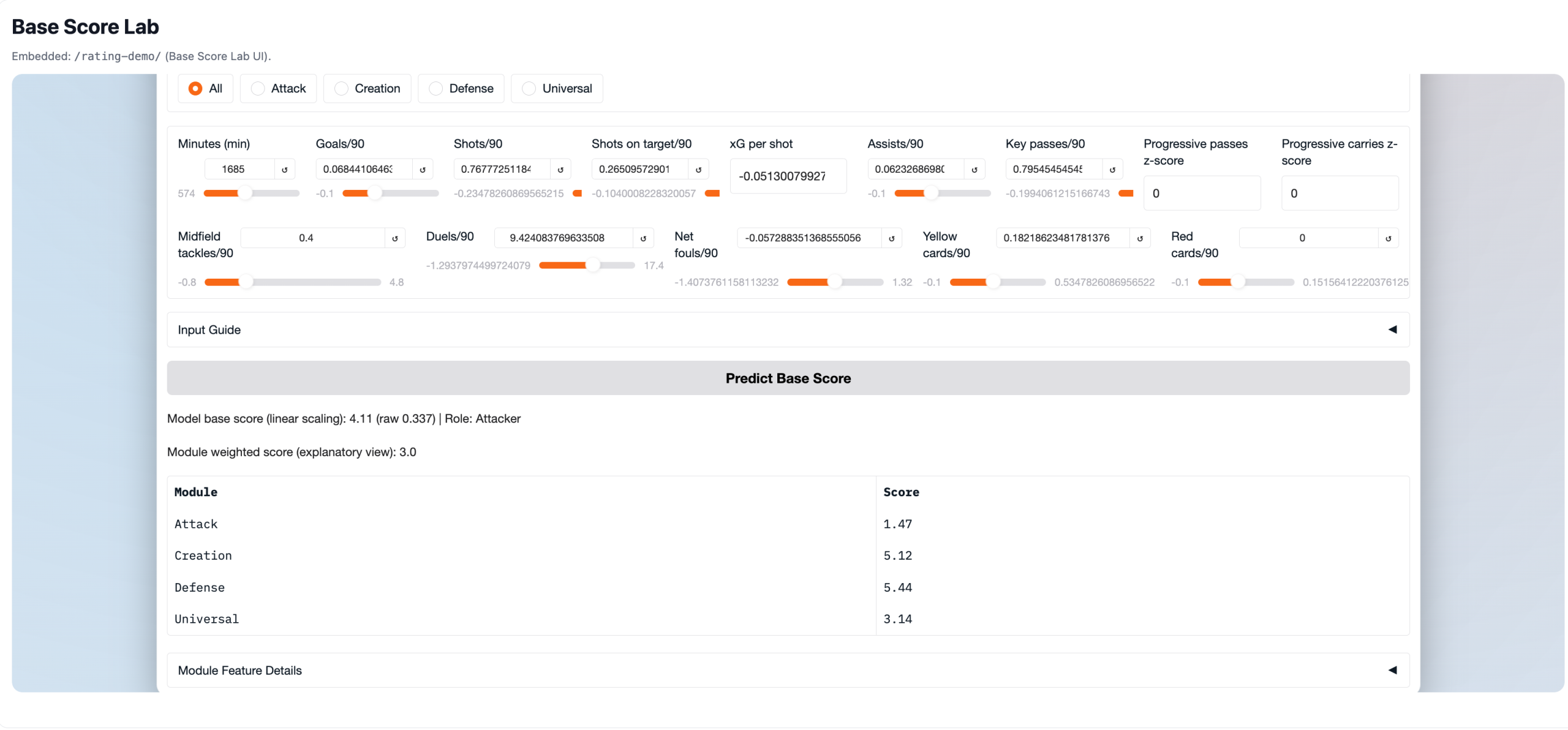
Athlemetrics isn’t just raw data. It’s a platform designed to be explored. Visualize predictions, debug feature inputs, and analyze team structures directly in the Base Score Lab.